AQuRA
An industry consortium builds a transportable strontium optical clock
Taking an optical clock out of the lab
The best optical clocks would lose less than a second over the age of the universe, but they fill entire laboratories. Many applications, from geodesy and network synchronization to, one day, clocks in space, need clocks that can be moved, switched on, and trusted. That is the aim of AQuRA, the Advanced Quantum Clock for Real-World Applications: an EU Quantum Flagship project, coordinated by our group, in which an industry consortium builds a transportable strontium optical lattice clock. The consortium brings together industry, national metrology institutes and universities, and calls the result the first industry-led clock prototype. The target is a high technology readiness level (TRL 7).
Our contribution: optics that stays aligned
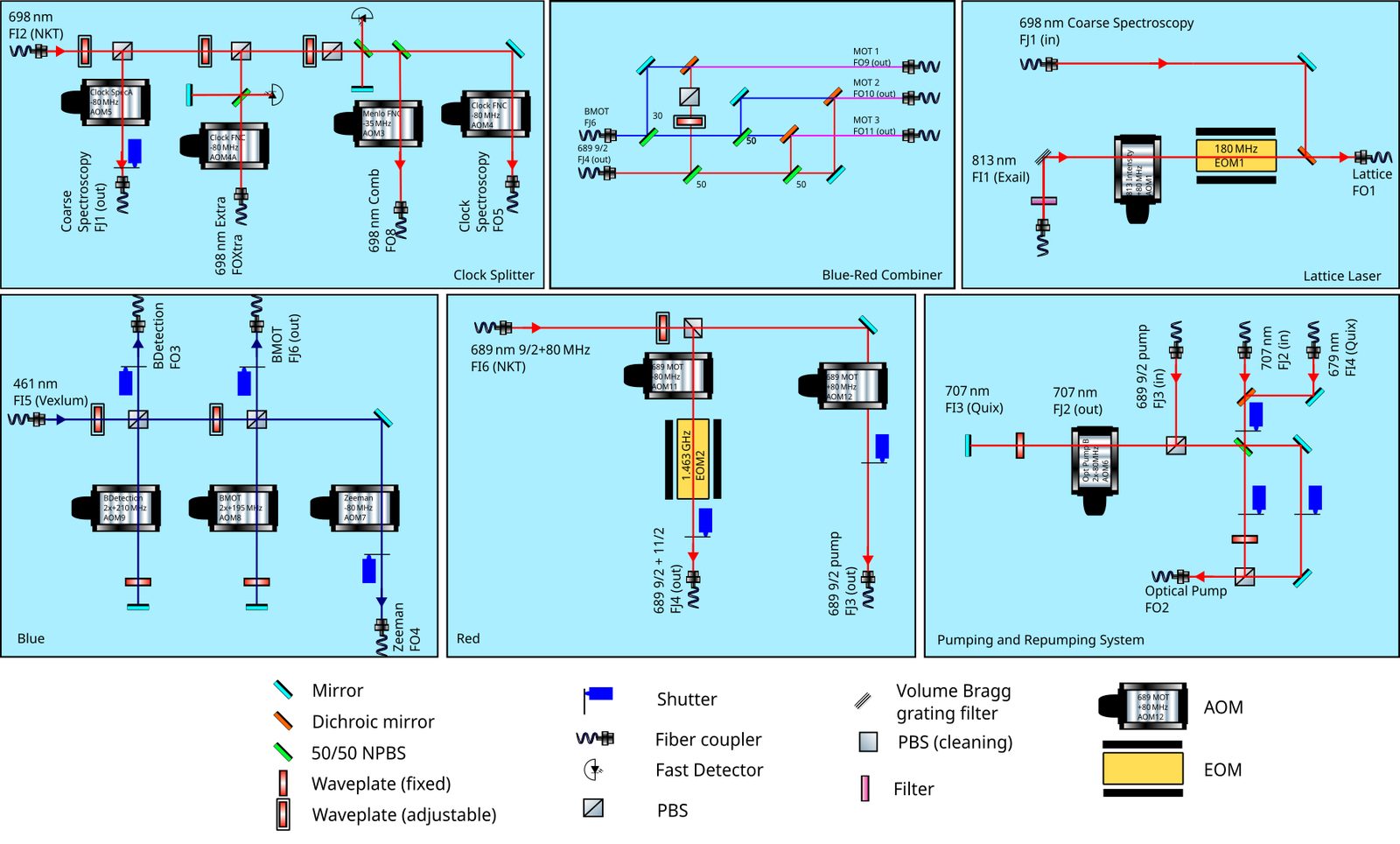
A strontium lattice clock needs light at many wavelengths, each with the right frequency, power and timing: 461 nm and 689 nm for the blue and red magneto-optical traps, 813 nm for the magic-wavelength lattice, 698 nm for the clock transition itself, and further wavelengths for optical pumping and repumping. In a lab, this is done with hundreds of mirror mounts on an optical table, which is flexible but fragile.
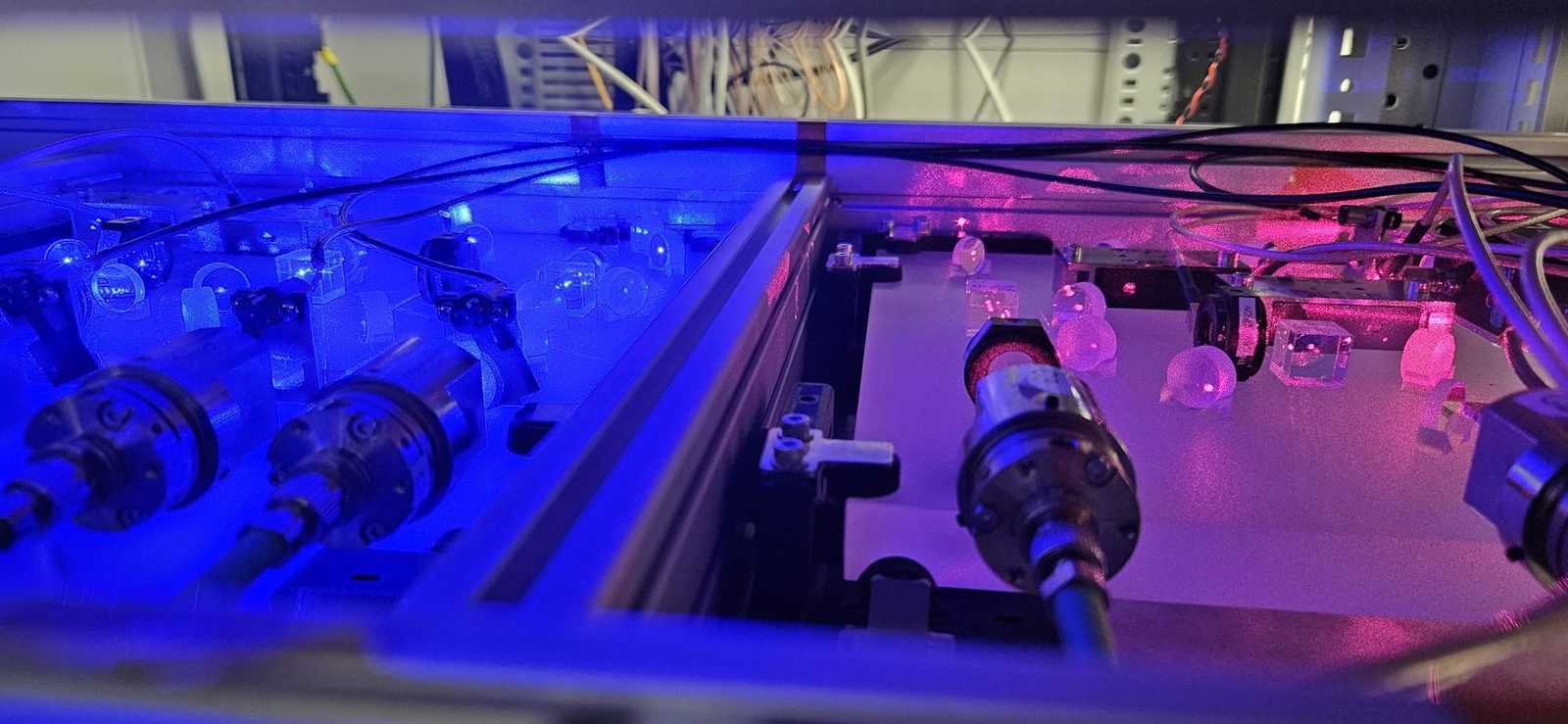
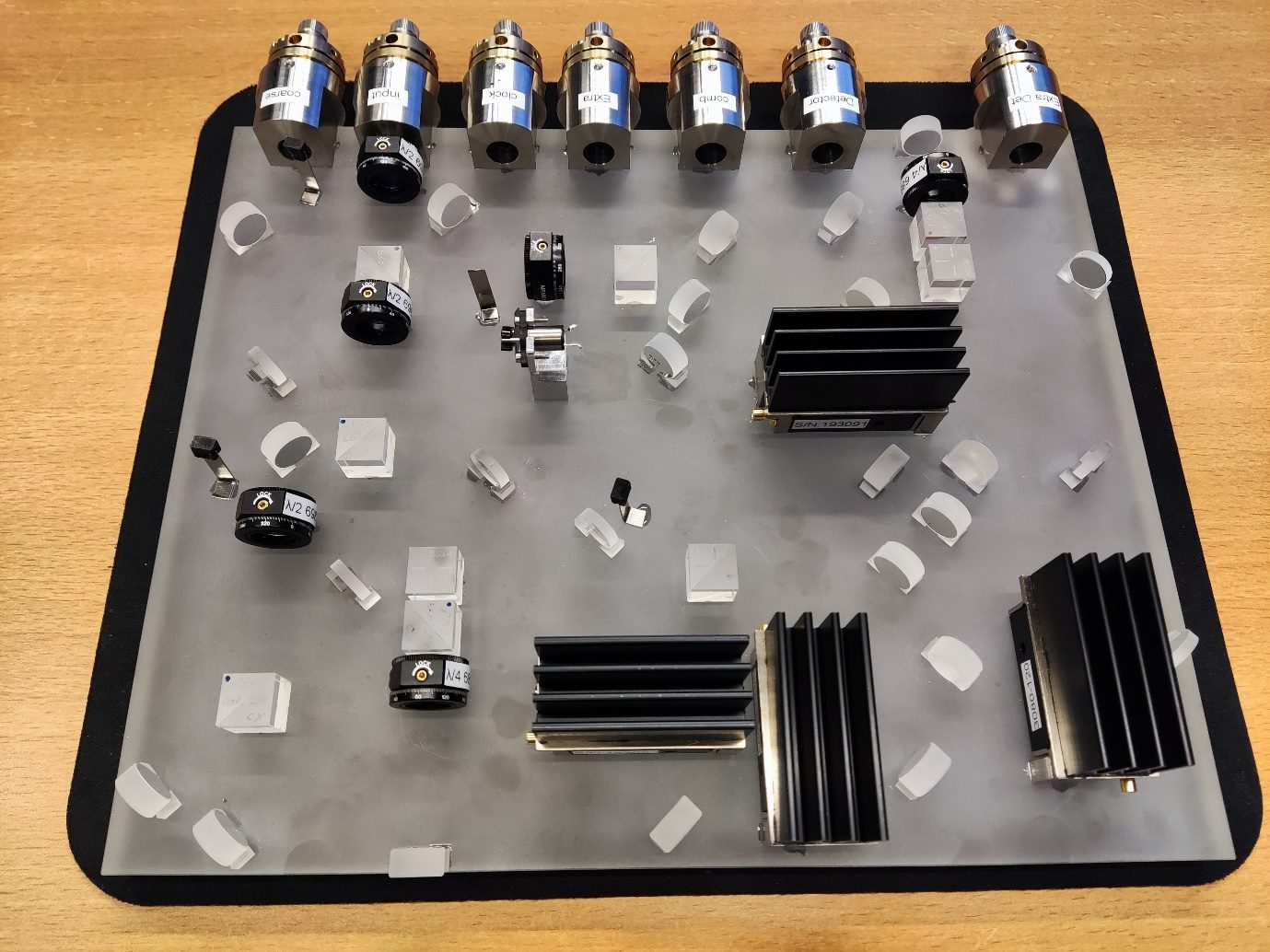
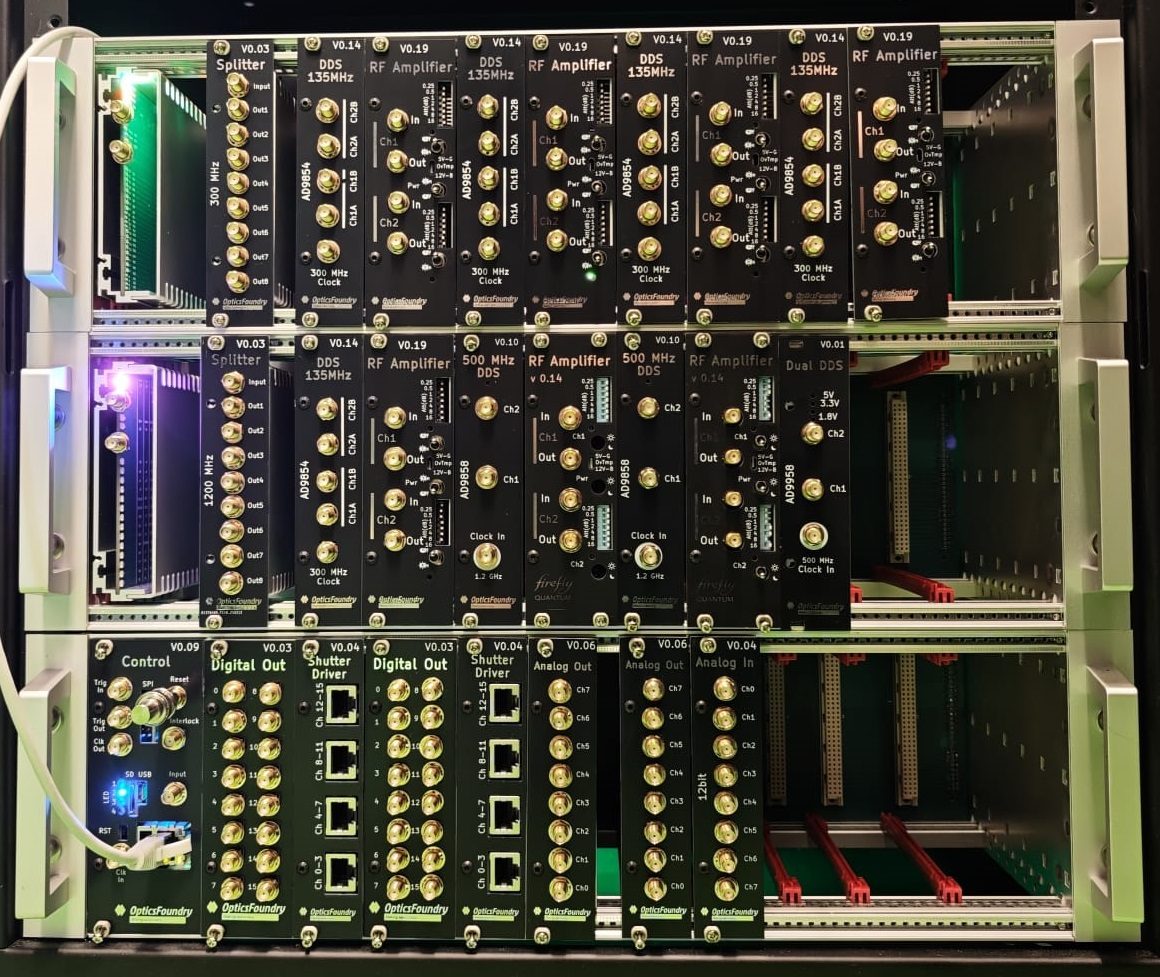
For AQuRA we instead built six compact optical circuit boards: for the 698 nm clock light distribution, the blue and red laser cooling light, a combiner for the red and blue beams, the lattice laser, and optical pumping and repumping. Each board carries its optics bonded onto a rigid glass baseplate, with fibers in and fibers out, so it behaves like any other component in a rack. We also delivered the control electronics and the low-level software that drive the boards: an FPGA sequencer, direct digital synthesizers, RF amplifiers, shutter drivers and analog and digital input and output.
Status
The clock is being completed with our industrial partners. The partners will continue the work even after the official end of the project (November 2026), until the clock ticks as it should.
From project to company
The AQuRA optics and electronics were developed by the team that now runs our spin-off OpticsFoundry. The boards built for AQuRA were its first boards, and the lessons learned in AQuRA, about what it takes to make laser optics robust, transportable and reproducible, are now its business. For a physics student, AQuRA is a good example of how research in an academic lab can turn into technology that leaves the lab.
Gallery