kHz superradiant laser
A hot strontium beam, one cavity, and the goal of continuous superradiance
A laser whose frequency is set by atoms
An ordinary laser takes its color from its cavity: the distance between the mirrors decides the frequency, so every vibration and every temperature drift ends up in the light. That is why the best clock lasers are locked to ultrastable reference cavities, which are engineering masterpieces in their own right. A superradiant laser turns this around. It operates in the bad-cavity regime, where the cavity linewidth is much broader than the linewidth of the atomic transition. The coherence of the laser is then stored mainly in the collective dipole of the atoms rather than in the photons, and the laser frequency becomes much less sensitive to the cavity length. The atoms synchronize and radiate together, a bit like Huygens' famous pendulum clocks that fall into step when they hang from the same beam.
How the machine works
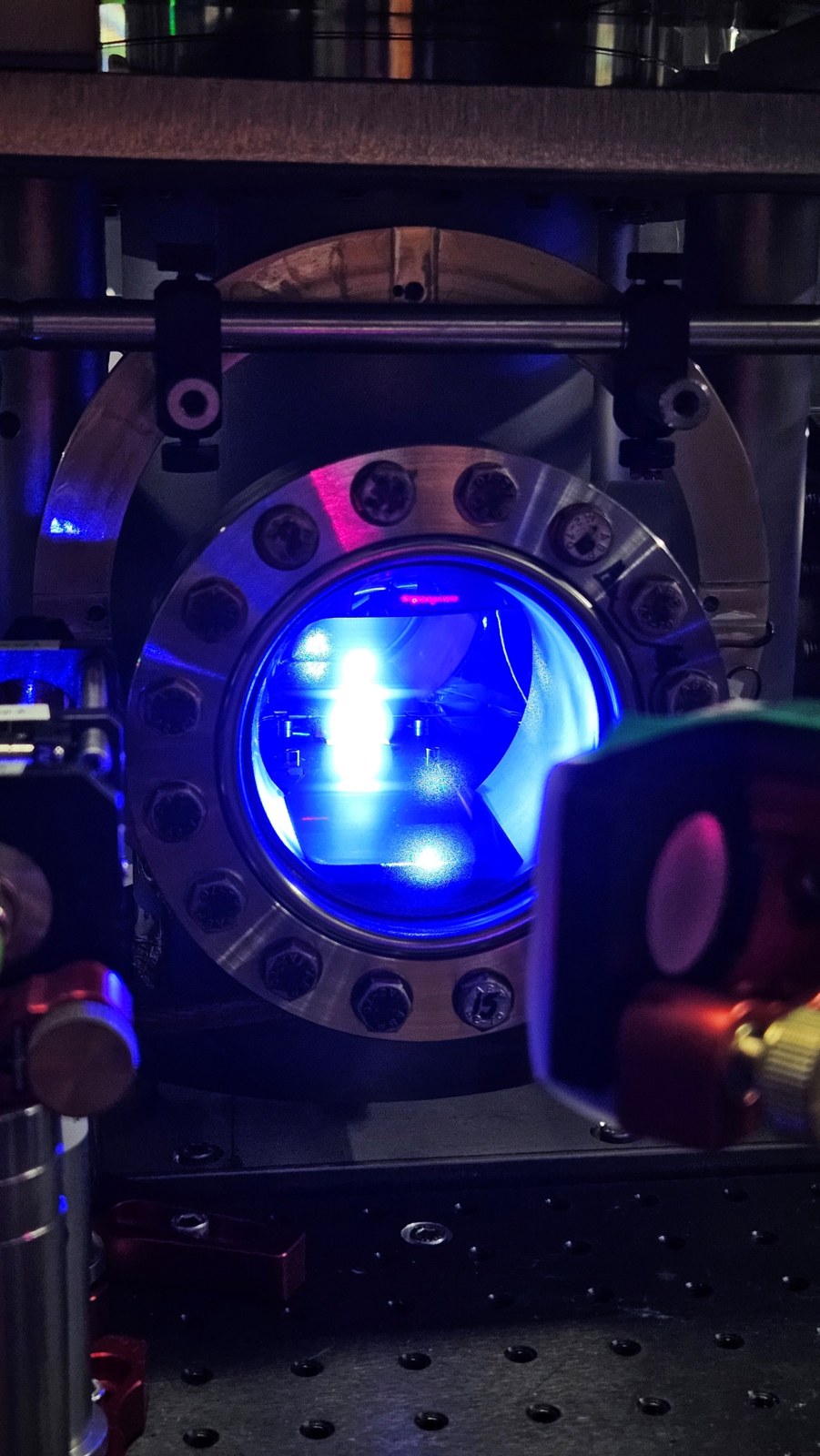
Our kHz superradiant laser is a deliberately simple machine. An oven produces a dense beam of strontium atoms that travels through a compact vacuum chamber. All stages run continuously and sit next to each other in space, rather than following each other in time: laser beams collimate the atomic beam, prepare the atoms in the upper lasing state 3P1 of the 7.5 kHz-wide 1S0–3P1 intercombination line at 689 nm, and the atoms then fly through the mode of an optical cavity, where they interact collectively with the light. The design builds on a 2020 proposal by the Holland and Nicholson groups for a rugged superradiant laser driven by a hot atomic beam.
“Simple” is not the same as “easy”, though. The theses of Sheng Zhou, Francesca Famà and Camila Beli Silva tell the story of several upgrades: a new oven, a new cavity, new ways to prepare the atoms, and skimmers that stop strontium from coating the windows.
What we have published
In Continuous cavity-QED with an atomic beam (Phys. Rev. A, 2024) we showed that the atomic beam reaches collective strong coupling with the cavity, visible as a normal-mode splitting, and that an inverted beam provides continuous optical gain. A key challenge is cooling such a dense beam: standard optical molasses becomes unbalanced when the atoms absorb a large part of the light. Our answer is Swept Velocity Shelving (arXiv, 2026). It pairs a broad transition that shifts the atomic velocities with a narrow transition that selects them, and it parks the selected atoms in a long-lived state, where they no longer scatter light.
Where it is heading
Our goal is continuous superradiant lasing on a narrow optical transition. Pulsed superradiant lasing on the strontium clock transition was first demonstrated at JILA in 2016, but a clock laser has to run continuously. Because our approach needs no laser cooling to microkelvin temperatures, a future version could be packaged as compactly as a cesium beam clock and used outside the lab. The machine is also a pathfinder for its sibling in the same lab, the mHz superradiant clock, and a playground for collective light–matter physics.
The project started within the EU Quantum Flagship project iqClock, which our group coordinated. It now continues within the training networks MoSaiQC and QuRIOUS and the QDNL quantum sensing testbed.
Working on the kHz laser
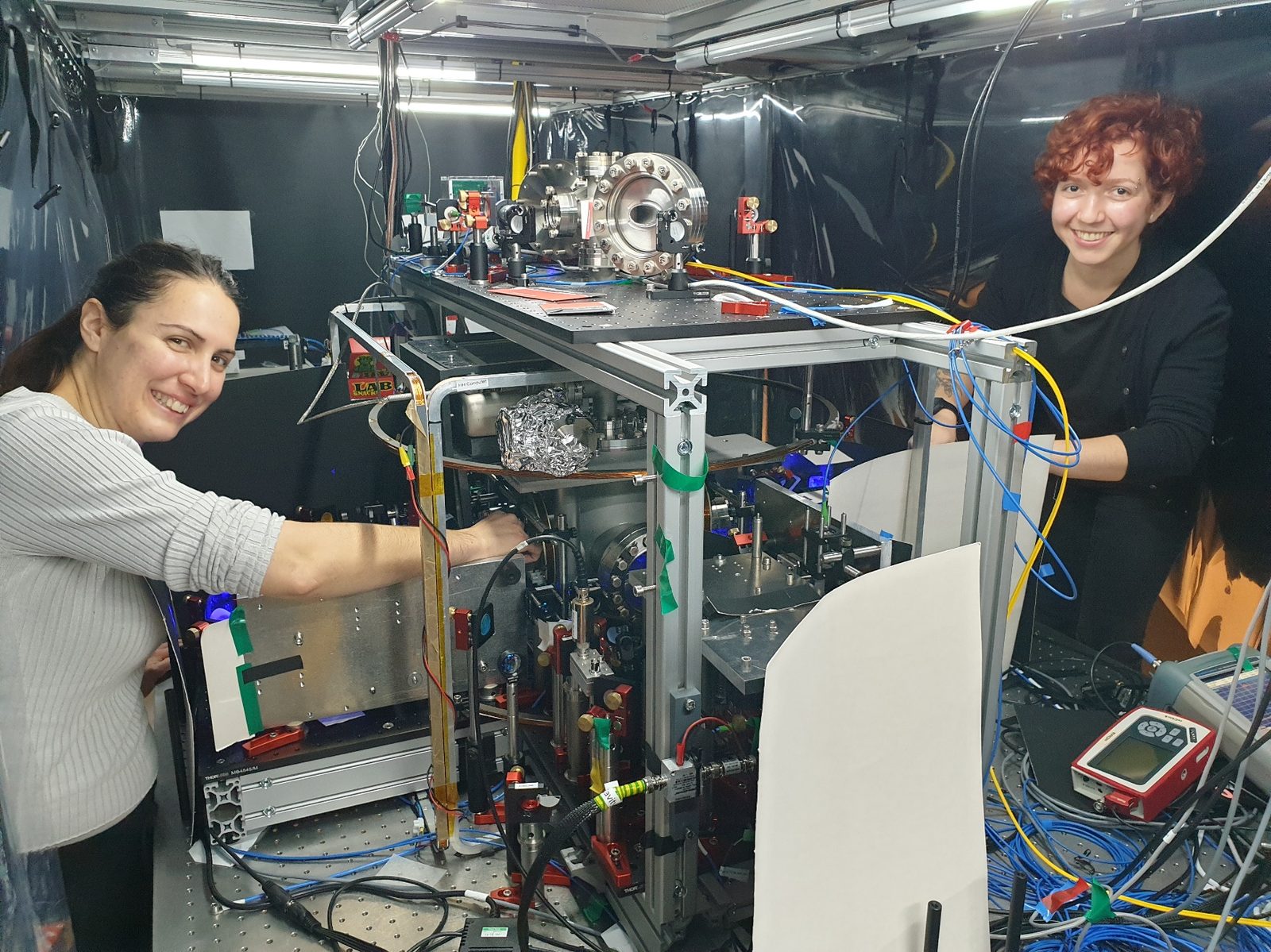
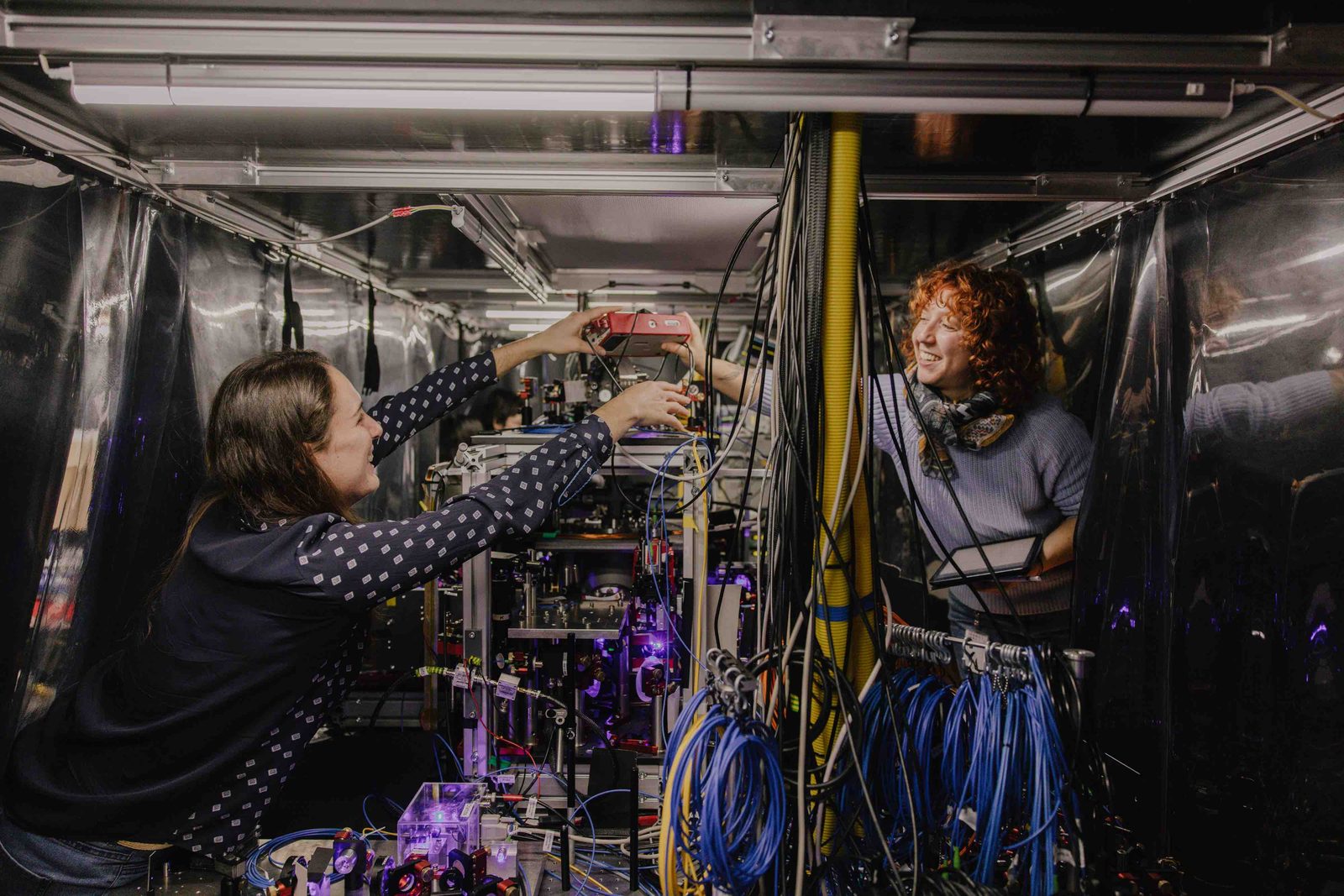
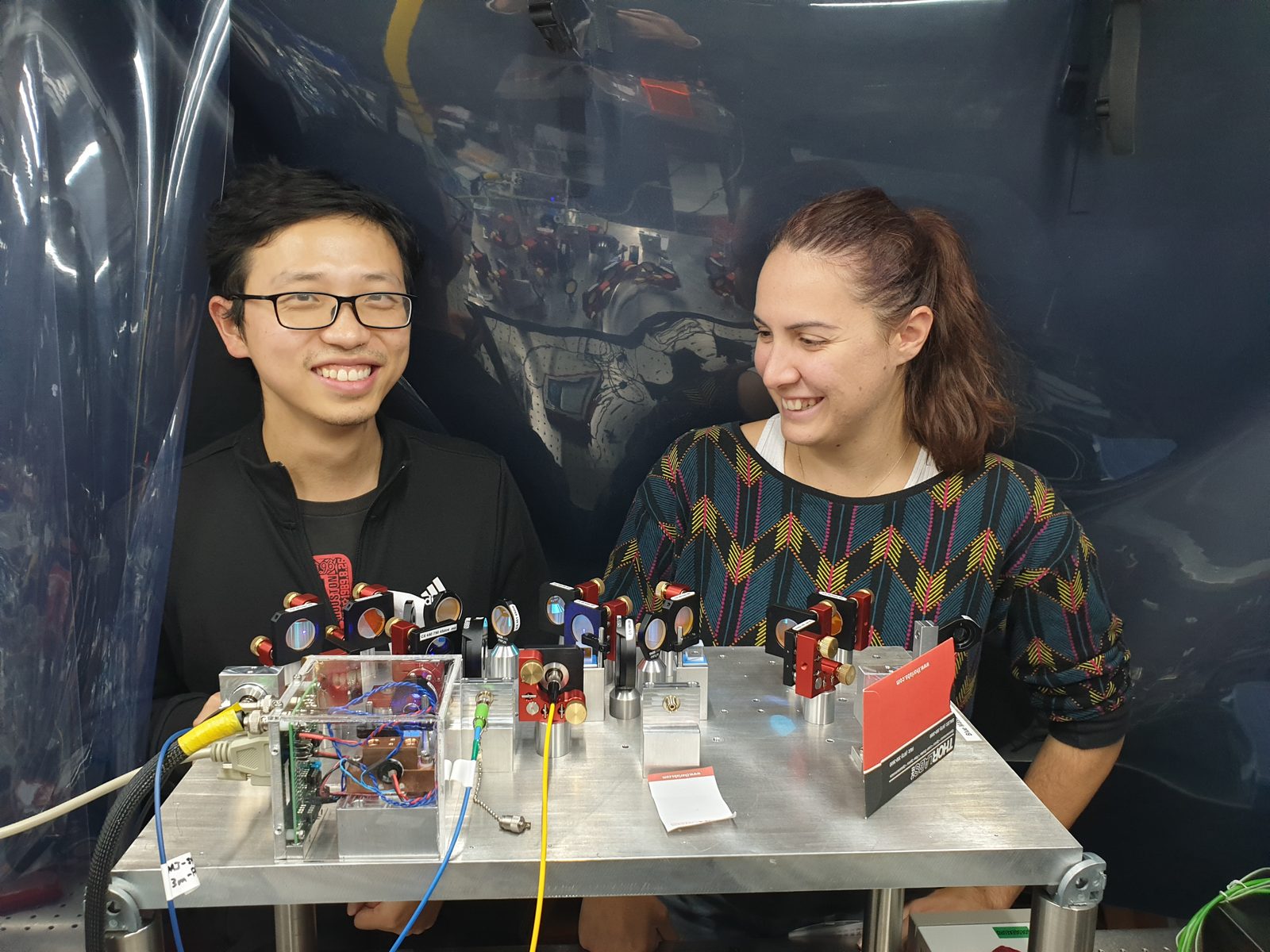
The team is small, so everyone gets to touch everything: vacuum and oven, cavity locks, data analysis, and the lasers. All lasers in the apparatus are home-built, including the electronics for temperature and current control and for laser stabilization. We work closely with theorists, since an atomic beam crossing a cavity is a surprisingly rich many-body problem. If you like a machine that you can understand from end to end (and you don't mind the occasional fight with a strontium-coated window), this is the place for you.
Gallery