mHz superradiant clock
Towards an active optical clock on strontium's millihertz clock transition
Atoms in no hurry
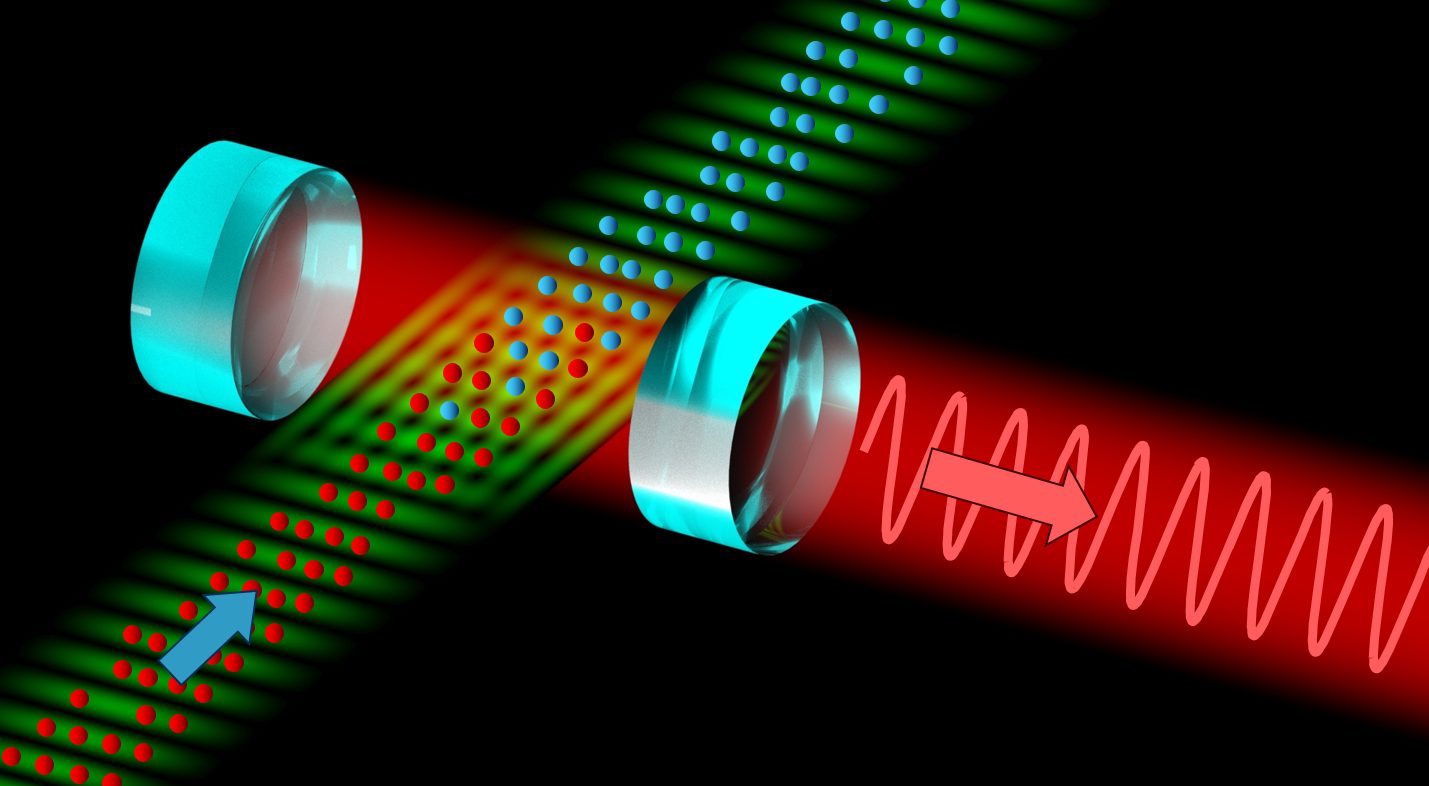
Strontium's 1S0–3P0 clock transition at 698 nm has a natural linewidth in the millihertz range. An excited atom typically waits more than a thousand seconds before it emits a photon. That patience is exactly what makes the transition such a good frequency reference, and also why you cannot simply build a laser on it: the atoms are in no hurry to emit. Superradiance changes that. When many atoms emit in phase, the emitted power grows with the square of the number of atoms, which is enough to get useful light out of even this extremely narrow line. In the bad-cavity regime, such a laser takes its stability from the atoms, not from the mirrors.
A continuous superradiant laser on the clock transition would be an active optical clock: the atoms themselves would produce the clock light. Such clocks have been proposed as a way to improve the short-term stability of optical clocks and to relax the extreme demands on ultrastable reference cavities. Pulsed superradiant lasing on the strontium clock transition was demonstrated at JILA in 2016, but a clock has to keep ticking, so the lasing has to be continuous.
Feeding the cavity without a break
Continuous superradiance needs a continuous supply of fresh, ultracold atoms that replace the ones that have already emitted. Our lab has been developing exactly this kind of source for years, from a steady-state magneto-optical trap (2017) and a guided ultracold strontium beam with high phase-space density (2019) to continuous Bose-Einstein condensation (2022). The mHz machine builds on these techniques. It combines a high-flux source of microkelvin-cold atoms with a separate science chamber that contains a ring (bow-tie) cavity. There, the atoms are to be slowed, loaded into the cavity, optically pumped into the upper clock state 3P0, and left to emit together. Our design, together with simulations of cooling, loading, pumping and the superradiant emission itself, is published in Phys. Rev. Research (2025).
Results so far
Sheng Zhou's thesis describes the construction of the machine and its steady-state 88Sr magneto-optical trap on the 7.5 kHz-wide intercombination line. The trap performs similarly to the one in our atom-laser machine, but in a more compact design with a permanent-magnet Zeeman slower. On this source we developed two techniques that are useful well beyond superradiance:
- A quasi-continuous sub-microkelvin strontium source that needs no laser locked to a high-finesse cavity. Instead, a fiber frequency comb with sub-kHz linewidth provides the reference. Its long-term stability comes either from a 10 MHz signal from VSL, the Dutch national metrology institute, or from a narrow-line magneto-optical trap (Phys. Rev. Applied, 2026).
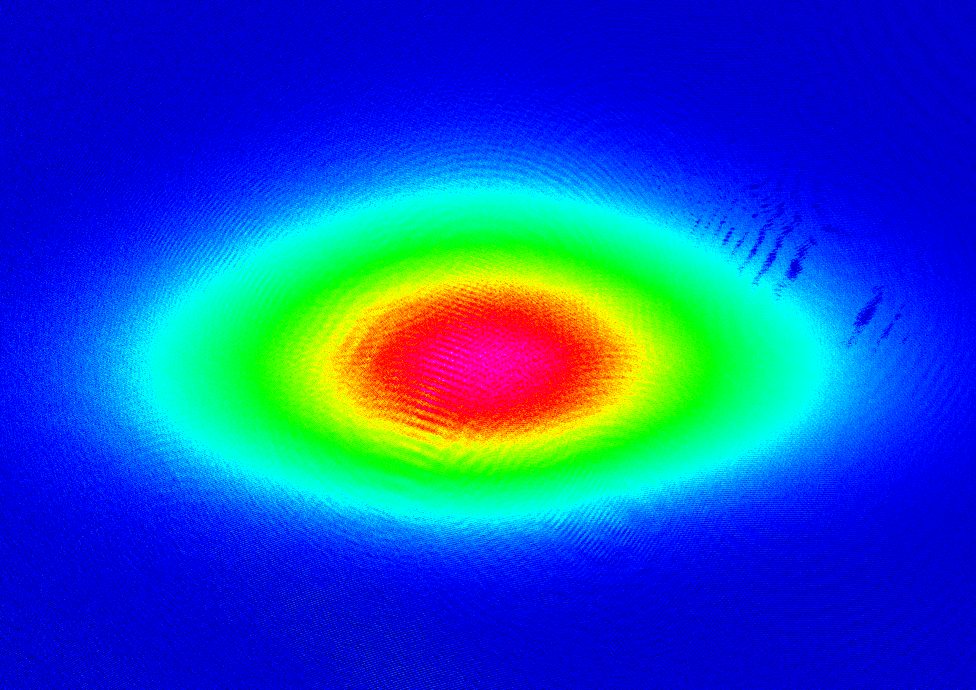
- Continuous cloud position spectroscopy. The position of a magneto-optical trap on a narrow line depends on the laser frequency, which turns the atom cloud into a continuous frequency sensor that outperforms conventional hot-vapor spectroscopy (Phys. Rev. Applied, 2026).
What's next
The next milestones are loading the atoms into the cavity, pumping them into the clock state, and observing first pulsed and then continuous superradiant emission on the clock transition. Beyond that, the machine opens the door to continuous, cavity-enhanced clock spectroscopy and to theory proposals such as storing spin-squeezed states in collective dark states of the atoms.
Working on the mHz clock
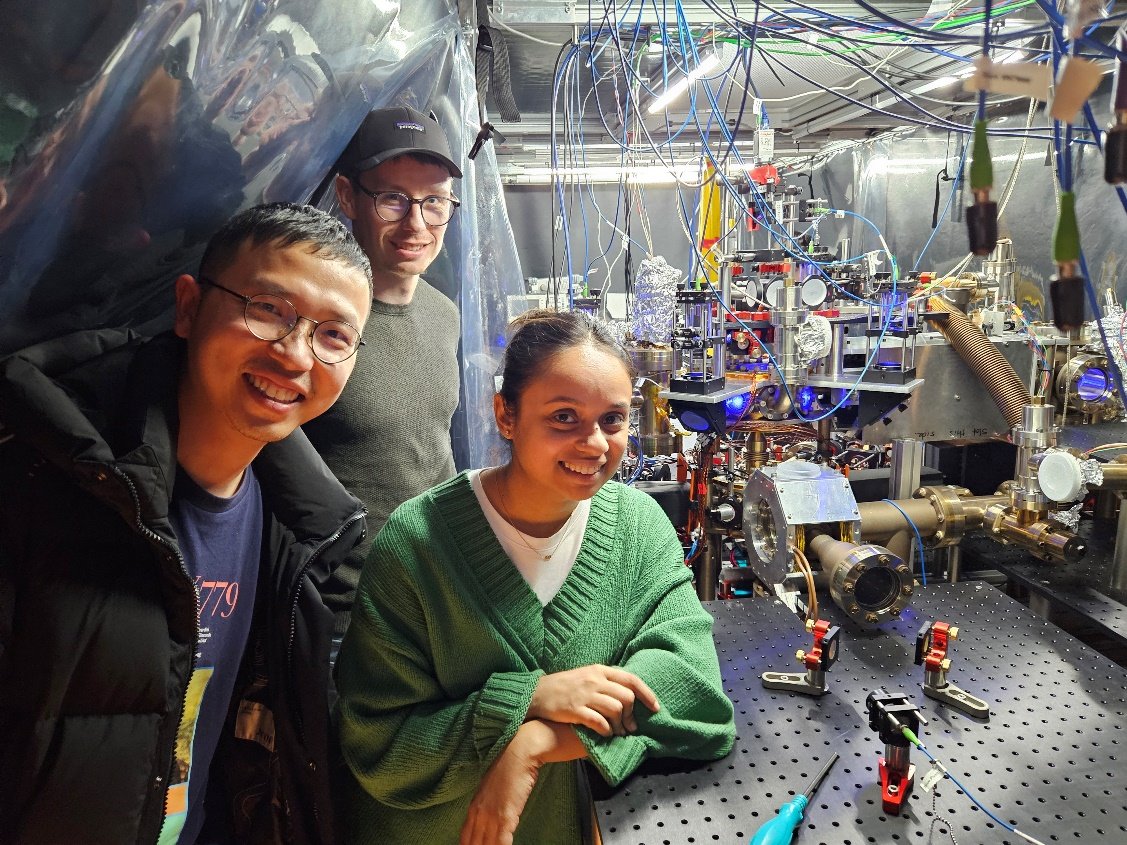
PhD students Ying Cui and Haiwei Wang run the machine, supported by Benedikt Heizenreder and Ananya Sitaram. It shares lab D0.137 with the kHz superradiant laser and a lot of physics, and master students regularly join the team. Expect a big, many-stage machine: blue and red magneto-optical traps, dipole guides, a ring cavity, and a lot of lasers that all have to work at the same time, without a break.
Gallery